If you've started pricing up a bespoke kitchen in Cambridge, you'll already have noticed the numbers vary enormously. Two quotes for what looks like roughly the same room can sit £20,000 apart, and nobody explains why. £40,000 to £60,000 is where most genuinely handmade, in-frame kitchens in this region actually land, and there's a real, explainable difference between the bottom and the top of that range.
This isn't a reassuring marketing bracket. It's a reflection of what it costs to build cabinetry by hand, from solid timber, fitted to one specific room — rather than assembled from a factory carcase system with a painted door hung on the front. What follows is a straightforward account of what that money buys, and what changes as a project moves from £40,000 towards £60,000 and beyond.
What "Bespoke" Actually Means
The word gets used loosely. A great deal of what's sold as bespoke is, in practice, a modular kitchen: cabinets built to standard carcase widths — 300mm, 600mm, 900mm and so on — with a painted or foil-wrapped door fixed to the front, and any gap left by an awkward room filled with a strip of matching panel. It can look perfectly good in a photograph. It isn't bespoke in the sense the word used to mean.
A genuinely bespoke kitchen starts with the room, not a catalogue of standard widths. If a run measures 3,847mm, the cabinet is built to 3,847mm — not a stock module plus a 47mm filler strip dressed to match. That distinction alone accounts for a meaningful part of the price gap between an off-the-shelf "bespoke" kitchen and one built this way: it is simply far more work to build to a single, unrepeatable dimension than to assemble a repeatable module, however nicely it's finished.
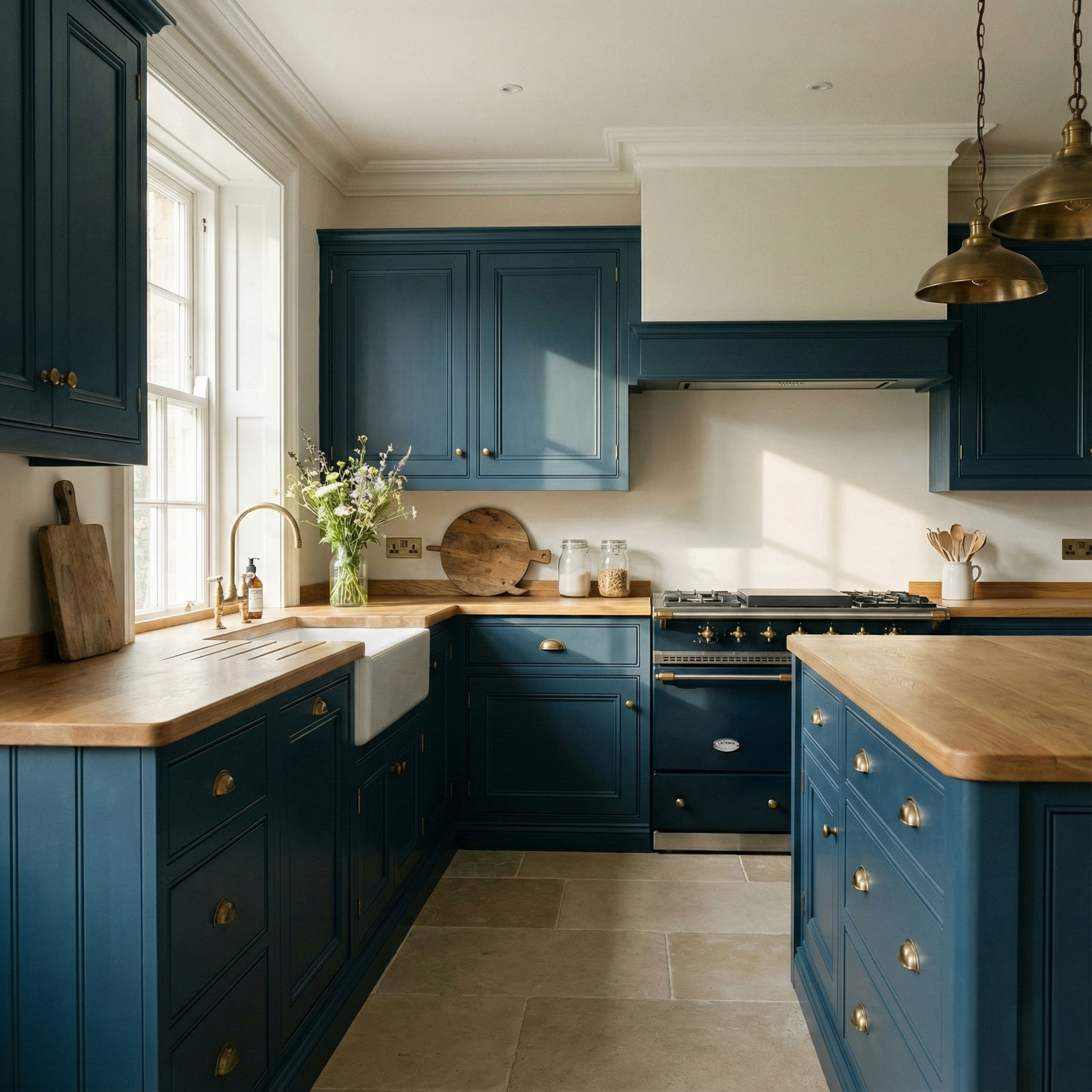
You can see what this looks like finished in our kitchen collections.
In-Frame Cabinetry, Explained
Most of what you're actually paying for in this bracket is a method of construction that few kitchen buyers have had properly explained to them: in-frame.
A standard kitchen door — including most higher-end factory kitchens — is "lay-on" or overlay construction. The door sits flat across the front of the cabinet box, overlapping its edges. It's a sensible way to build a kitchen quickly, and there's nothing wrong with it for what it is.
In-frame construction is a different job entirely. Each cabinet has a solid timber face frame — solid tulipwood in our work, built to around 36mm — and the door is hung within that frame, sitting flush inside it rather than lying over it, the way an old piece of English furniture would have been made a century or two ago. Every frame has to be built square. Every door then has to be fitted individually into its own opening, with a consistent reveal running around it, by hand. There is no machine that fits doors any faster than a joiner with a plane and a good eye.
Doors in this price bracket are usually painted Shaker — a plain, recessed-panel design that has stayed in more or less continuous use since the early nineteenth century, because the proportions sit comfortably in almost any house, from a Victorian terrace to a timber-framed farmhouse.
Why Two Same-Size Kitchens Can Cost Very Different Amounts
This is the question we're asked most often — usually by someone holding two quotes for what looks like the same room, unable to account for a £15,000–£20,000 gap between them.
Floor area is only one input, and often not the largest one. The bigger drivers are:
- The amount of cabinetry, not just the floor space. A run of cupboards is considerably cheaper than the same length built as drawers.
- Drawer construction. Ours are solid oak, jointed with traditional dovetails, running on Blum Movento concealed soft-close runners — a different proposition, in cost and in how long it lasts, to a stapled MDF drawer box on a basic runner.
- Internal specification. Plate racks, larder pull-outs, bin storage and bespoke cutlery or utensil trays are all joinery in their own right, and none of it is visible until the door is open.
- Hardware. Solid brass hinges and handles age and develop a patina; plated pressed-metal hardware doesn't age gracefully, and tends to look tired within a few years.
- Worktop material. Timber, engineered quartz, and honed or polished natural stone are priced very differently, before you even factor in edge profiles or drainer grooves.
- Design complexity. A straight run against a flat wall is one job. Scribing cabinetry around a chimney breast, a sloping ceiling or a period cornice is another.
- Installation. Site access, how many other trades need coordinating around the fit, and how much of the existing room needs making good before we start, all affect the final figure.
Two kitchens can occupy an identical footprint and differ by £20,000 purely on the combination of the factors above. For a fuller breakdown of how we price a project, see our kitchen pricing guide.
What Changes Between £40,000, £50,000 and £60,000
Every project is quoted individually, but there's a genuine pattern to what a given budget typically buys. The table below is a general guide, not a fixed price list.
| What changes | Around £40,000–£50,000 | Around £50,000–£60,000 | £60,000 and above |
|---|---|---|---|
| Cabinetry | A compact-to-medium in-frame kitchen, painted Shaker doors, straightforward runs | A larger or more heavily fitted kitchen, often extending into a family or dining area | Extensive cabinetry, frequently spanning several rooms or a full kitchen–dining–utility scheme |
| Drawers | Solid oak dovetail drawers on the principal runs | Solid oak dovetail drawers throughout, including secondary storage | Solid oak dovetail drawers throughout, with bespoke internal fitting to most |
| Worktops | Engineered quartz or a modest natural stone | Upgraded natural stone becomes realistic, such as honed marble or quartzite | Premium natural stone, often with more complex edge detailing or larger slabs |
| Island | Rarely included, or a small peninsula at most | A single island is common at this level | A substantial island, occasionally more than one |
| Larder / pantry | Not usually included as a separate piece | A fitted larder cupboard or pull-out pantry is often achievable | A dedicated larder or walk-in pantry room is realistic |
| Bespoke internals | Standard shelving and drawer configuration | Plate racks, bin stores and tailored internal fittings in key cabinets | Bespoke internal joinery throughout, designed around how the kitchen is actually used |
| Appliances | A reliable mid-to-upper integrated appliance package | Premium integrated appliances, sometimes including a range cooker | A full high-specification appliance suite |
| Complexity | Relatively few scribes or awkward junctions | Some scribing to period features is typical | Extensive scribing to historic fabric, beams or uneven walls is common |
| Installation | Quoted and delivered separately from the cabinetry price | Quoted and delivered separately from the cabinetry price | Quoted and delivered separately, often with more site coordination required |
Worktops, appliances and installation are priced separately in every case — they are never folded silently into the headline cabinetry figure, whatever the budget.
Cambridge's Period Homes — Why Local Architecture Changes the Price
Much of our work is in villages around Cambridge — Grantchester, Harston, Trumpington, out towards Newmarket and into Suffolk — where a genuinely straight wall or a level floor is the exception rather than the rule.
A kitchen built into a new-build extension, with square corners and a flat ceiling, is a comparatively simple fit. A kitchen going into a cottage with exposed ceiling beams, a sloping floor and a chimney breast that isn't quite where the original drawings say it is, needs every cabinet individually scribed on site — cut and fitted to the real, imperfect surface behind it, not the theoretical one on the plan. That's slower, more skilled work, and it's one of the quieter reasons period properties in this area tend to sit toward the upper half of the £40k–£60k range, or above it.
Footage from a recent Cambridge Bespoke in-frame kitchen project near Harston, Cambridgeshire — one of the villages where this kind of scribed, room-specific fitting is the rule rather than the exception.
A Word on Value, Not Just Price
Materials, construction and finish should be specified for the individual project, with repairability and maintenance considered alongside appearance. Hand-painted solid timber cabinetry can typically be rubbed down and resprayed, and oak dovetail drawers and solid brass fittings can usually be repaired or refinished rather than replaced outright, but actual longevity depends on construction quality, usage and upkeep in each case.
Frequently Asked Questions
What does £40,000 actually get you in a bespoke kitchen in Cambridge?
At the entry point of this bracket, £40,000 typically buys a compact-to-medium in-frame kitchen with painted Shaker cabinetry, solid oak dovetail drawers on the main runs, an engineered quartz or modest natural stone worktop, and a straightforward layout without an island. Installation is quoted separately.
Is a £40,000 kitchen genuinely bespoke, or is that still a "premium modular" kitchen?
At Cambridge Bespoke, £40,000 still buys genuinely bespoke, in-frame construction — cabinetry built to your exact room dimensions, not a modular carcase system. What tends to change as the budget rises isn't the honesty of the construction, but the scale and complexity of the project: more cabinetry, more bespoke internal fitting, and a wider choice of materials.
Why do oak dovetail drawers cost more than standard drawers?
A dovetail joint is cut, not stapled or glued on a jig, and takes considerably longer to make. In exchange, it's mechanically far stronger under the repeated racking stress of daily use, and it can be repaired rather than replaced if it's ever damaged. Combined with quality runners such as Blum Movento, it's a drawer built to be opened several times a day for decades.
Does the £40k–£60k figure include installation?
No. Installation is always quoted and delivered as a separate line item, once the design and site have been assessed, whether you choose our complete supply-and-fit service or supply-only cabinetry. It is never folded silently into the cabinetry price.
Do I need an island to spend £50,000–£60,000?
No. An island is common at this level because kitchens of this scale often have the floor space for one, but the budget can equally go into a larger run of cabinetry, more extensive drawer storage, upgraded worktops, or a fitted larder instead. The specification is built around how you actually want to use the room.
How much of the cost is the worktop versus the cabinetry?
It varies considerably by material. A modest engineered quartz worktop is a relatively small proportion of the total; a large area of premium natural stone, with complex edge detailing, can represent a substantial share of the budget on its own. Worktops are always priced and agreed separately from the cabinetry.
Can a bespoke kitchen in this range still include a larder or pantry?
Often, yes. A fitted larder cupboard or pull-out pantry is realistic from around the £50,000 mark, and a dedicated larder room becomes more achievable above £60,000, depending on what else is specified. We also build freestanding larders as standalone pieces, where a separate room isn't available.
How long does a bespoke kitchen in this price range take, from order to installation?
From final design sign-off, the build in our workshop typically takes 8 to 12 weeks, to allow the timber to be selected and acclimatised, the joinery precision-cut, and the initial coats of paint applied. Installation and final finishing on site generally add a further 2 to 3 weeks.
Thinking About a Project in This Range?
If £40,000–£60,000 is roughly where your own kitchen sits, we're happy to talk it through honestly — no pressure, no instant quote. Send a few photographs or a rough plan and we'll tell you what we think it needs.
Get in Touch